

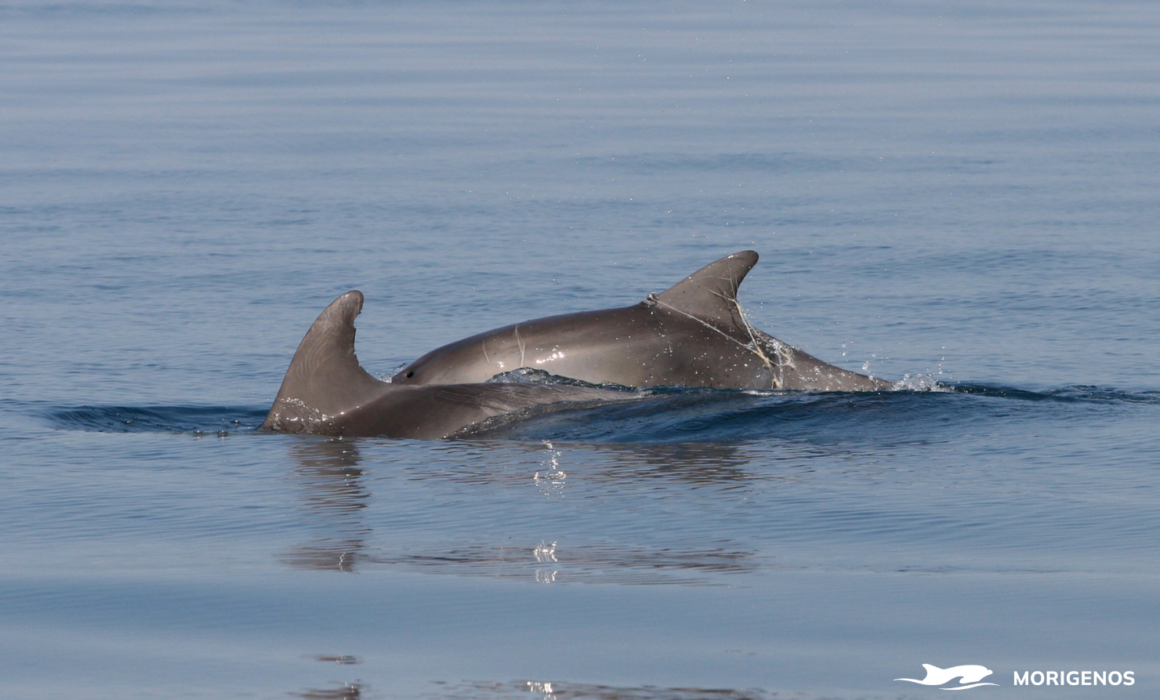
Young dolphin swam with a net for a year: a rare study from the northern Adriatic

Multidisciplinary study based on a rare case
The study was based on long-term monitoring of the animal and subsequent necropsy, which gave scientists a rare insight into the mechanisms and consequences of entanglement in fishing nets. Morigenos – Slovenian Marine Mammal Society monitored the young female, about one year old at the time, as part of long-term field monitoring, and researchers had known her and her mother for some time. During one of their observations, they noticed that the dolphin was carrying a piece of fishing net on her body. The net was caught on her dorsal fin, and part of the rope was embedded in the fin tissue. Photographs showed that at one point the net had also become embedded in her forehead, but it had later broken or come off on its own. Accidental entanglement in fishing gear often results in immediate death for whales and dolphins, especially smaller species, but in some cases the animals manage to escape with parts of the net or rope still attached to them. Cases of this type of long-term entanglement are well known in large whales, but are described much less frequently in dolphins.

Despite the prolonged entanglement, which lasted more than a year, the animal remained in good body condition during this period, indicating that entanglement is not necessarily fatal in certain cases, but nevertheless poses a serious and long-term risk to animals. Researchers monitored its condition and possible developments using photographic documentation and behavioural observations. During this time, the net penetrated deeper into the dorsal fin. Nevertheless, the animal was moving, diving, and behaving relatively normally. Researchers assessed that the matter would likely resolve itself without direct human intervention. Unfortunately, the story ended differently.
A year later, the dolphin got caught in another fishing net, which this time proved fatal. A thorough necropsy (animal autopsy) was performed at the National Veterinary Institute of the Veterinary Faculty in Ljubljana, in collaboration between Morigenos association and the National Veterinary Institute. During the necropsy, various samples were also taken for additional diagnostic tests. The results supported the conclusions based on field observations and confirmed the animal’s good physical condition. It also showed that the second entanglement in the net was independent of the first and that the original situation would probably have resolved itself.

What about intervention?
At this point, many people are probably asking themselves: “Why didn’t the experts help the animal during all this time?”
After the initial sighting, researchers carefully considered intervention options, but due to several limitations, they decided that intervention was not the best choice. Due to the animal’s mobility and behaviour, it was not possible to safely approach it or remove the net from a distance, which significantly limited the options. Any attempts to capture it could have caused additional stress, injury, or even death to the animal. As the calf was still dependent on its mother, any attempt to capture it could also have led to the separation of the pair or injury to both, posing an additional unacceptable risk to both the calf and its mother. Observations showed that the animal was mobile, in good physical condition, and clearly capable of hunting successfully, as confirmed by its long-term survival. It also appeared that the net might exit the dorsal fin again, which would solve the problem, as the net would then probably fall off the animal. The researchers therefore decided that further monitoring was the most sensible course of action, as they assessed the chances of survival as relatively good.
“Many people imagine that we can simply catch a dolphin, lift it onto a boat, remove the foreign object, and send it off. Unfortunately, things are not that simple with wild dolphins,” said Dr. Tilen Genov, the lead author of the study. “These are large, heavy, and agile animals that dive and do not allow themselves to be caught easily. They are also very different from land mammals, which complicates many procedures that would otherwise work on land animals. For example, it is not possible to sedate dolphins, and there is also a risk of so-called capture myopathy, where the animal can die from an acute stress response. Any measures must therefore be very carefully considered,” he added.
“The animal was in very good body condition,” said study co-author Dr. Tomislav Paller of the National Veterinary Institute, who led the necropsy. “Except for injuries related to the net itself, the animal was healthy and in good condition, including its internal organs, and had been feeding successfully.”
“It is extremely difficult to assess the animal’s health or prognosis in the field. However, the necropsy showed that our initial assessment was correct and that the animal had very good chances of survival. Unfortunately, its second encounter with a net did not end well, but the evidence suggests that this was independent from the first incident,” added Dr. Genov.
The role of fishermen
The authors emphasized that the cooperation of local fishermen was crucial to this study, as it was the fishermen themselves who informed the researchers about the captured dolphin and brought it back to port. This provided crucial insight into the event, which would not have been possible otherwise.
“We have a long-standing relationship and mutual trust with the fishermen,” said Dr. Genov. “Instead of discarding the animal at sea, as is usually the case in many parts of the world, the fishermen of Piran brought it to us, allowing us to learn something from it. Perhaps her death was not entirely in vain.”
All the facts indicate that the dolphin did not get caught in the net because it was depredating the fish caught in it, but rather that the entanglement was probably the result of curiosity, carelessness, inexperience, or a combination of these factors.
A sad but instructive case
This study is a rare example on a global scale of this type of insight into the mechanisms and consequences of entanglement in fishing nets. Scientists rarely have the opportunity to combine observations of live affected animals with detailed post-mortem examinations. The study raises important questions about when and how to intervene and clearly demonstrates the need for thoughtful, case-specific decisions about intervention. The findings from this case have also contributed to the development of global guidelines for action in the event of dolphins becoming entangled in fishing nets. The authors point out that the decision to “do nothing” (while monitoring the situation) is also a legitimate decision. Despite the sad outcome, the researchers hope that these findings will help in the future to better understand and prevent such events, where it will be important to know what to do and what not to do.
The study is available HERE (or upon request via email).


 Ali ste videli delfine?